Examining the Influence of the Urban Environment on Parents’ Time, Energy, and Resources for Engagement in Their Children’s Learning
Doctoral dissertation, Department of City and Regional Planning, University of California, Berkeley, 2013 · Funded in part by a HUD Doctoral Dissertation Research Grant
Committee: Elizabeth Deakin (chair), Karen Chapple, and Susan Stone
Abstract
Parents’ engagement in their children’s learning, at home, at school, and in the community, is one of the strongest influences on how children do in school, and gaps in that engagement help explain the income-based achievement gap. Yet school reforms focus almost entirely on what happens inside schools. This dissertation asks how the urban environment outside school, including transportation, housing, and neighborhood conditions, shapes the time, energy, and resources parents have for that engagement.
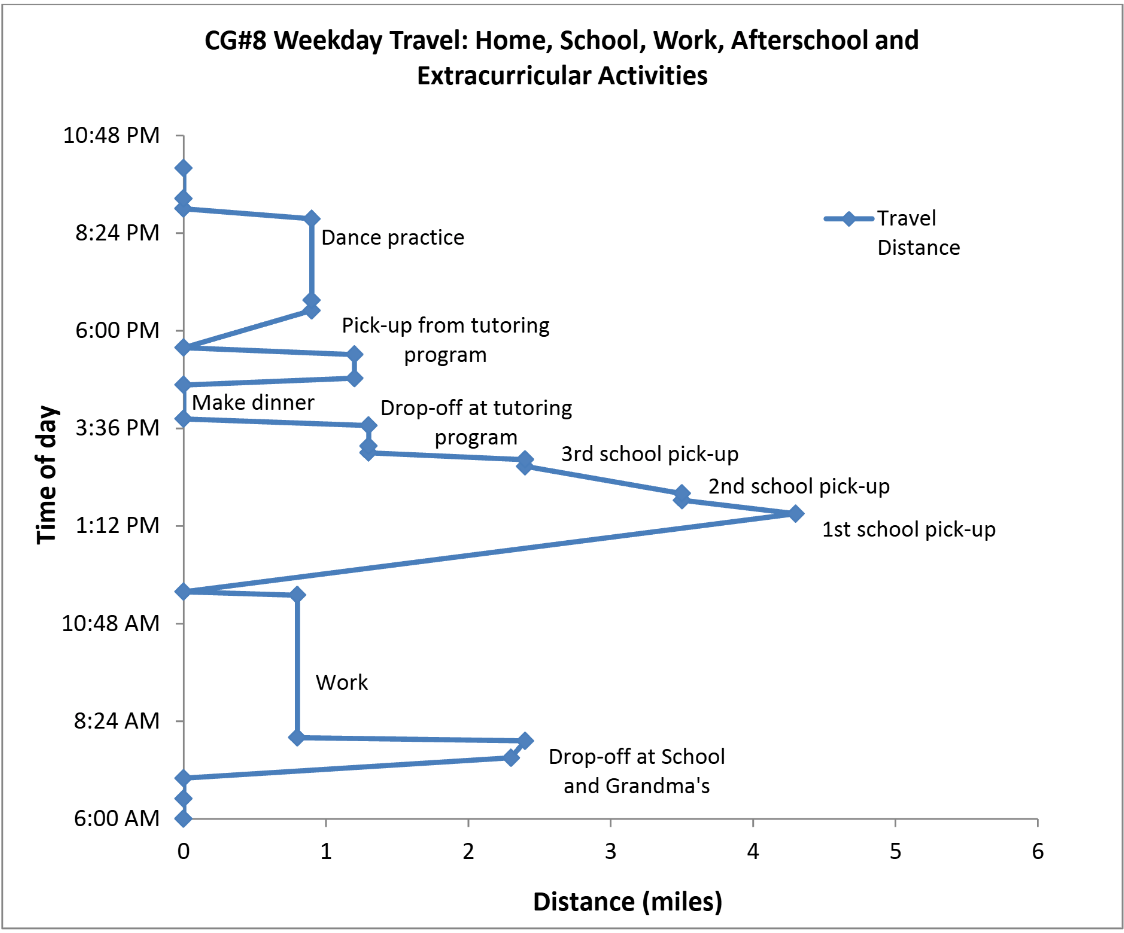
With support from a HUD Doctoral Dissertation Research Grant, I studied 70 families in low- and mixed-income neighborhoods of Oakland, California. I met most of them twice, almost always in their homes, and a bilingual team met with Spanish-speaking families. The mixed-methods design combined surveys, two-day time-use diaries, in-depth interviews, and neighborhood data, which made it possible to trace each parent’s daily travel among home, work, schools, child care, and activities, as in the time-space prism above.
Longer work hours reduced the time parents had for engagement, car ownership was associated with less time spent on child care and organizing, and having a school nearby was associated with more involvement at school. Low-income parents faced added barriers from frequent moves and from distant schools reached by slow, unreliable, and costly transit, while community organizations and social services helped parents of all incomes stay engaged. The findings point to transit, affordable and stable housing, and community development as tools planners can use to support children’s education.
Dissertation
Presentation
“Work, Housing, School and Transport Options in Oakland: Consequences for Families, Schools, and Regional Sustainability.” PhD Colloquium, University of Colorado Denver, September 9, 2013.
Related articles
- Makarewicz, C. 2018. Supporting parent engagement in children’s learning through neighborhood development and improvements to accessibility. Journal of Planning Education and Research.
- Makarewicz, C. 2013. Vouchers, magnet schools, charter schools, and options: Analyzing the effects of school and housing choices on mode choice to school. Transportation Research Record 2327: 1–8.

