Housing + Transportation Affordability: The H+T Index and Location Affordability
Center for Neighborhood Technology and Center for Transit-Oriented Development, Chicago, 2006–2008 · Studies for the Center for Housing Policy (supported by the MacArthur Foundation) and the Brookings Institution Urban Markets Initiative
With Peter M. Haas, Albert Benedict, Scott Bernstein, Thomas W. Sanchez, and Casey J. Dawkins
Abstract
The conventional rule that housing is affordable if it costs no more than 30 percent of income ignores what a location costs to live in. Households that move far from jobs and services to find cheaper housing often pay for it in higher transportation costs, the second-largest household expense. Before my PhD, at the Center for Neighborhood Technology (CNT) and the Center for Transit-Oriented Development, I co-developed the Housing + Transportation (H+T) Affordability Index, which measures the combined cost of housing and transportation for every neighborhood, and helped make “location affordability” an accepted term in local, regional, and national policy.
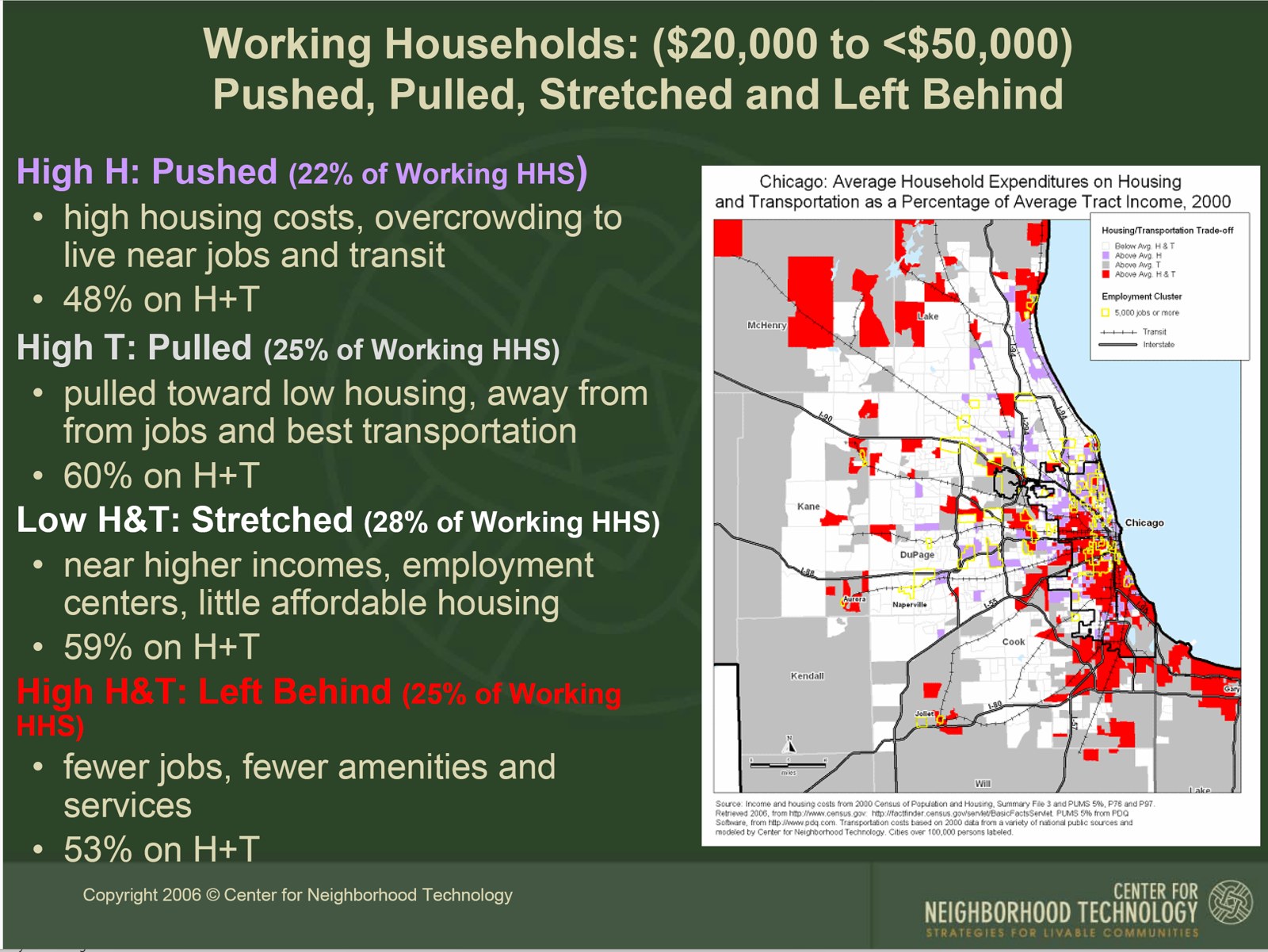
In a study for the National Housing Conference’s Center for Housing Policy, supported by the MacArthur Foundation, we applied the approach to working households in 29,607 census tracts across 28 metropolitan areas. Neighborhoods and regions with the highest combined costs were not explained by any single factor: high costs arose either from a few factors at the extreme, such as a shortage of affordable housing, long commutes, or congestion, or from several factors at moderate levels. Working households were pushed, pulled, stretched, or left behind. In the Chicago region, for example, working households spent 48 to 60 percent of their income on housing and transportation combined, whether they lived in high-cost neighborhoods near jobs and transit or in cheaper neighborhoods far from them.
The findings call for policies that locate affordable housing in concert with affordable transportation and jobs, particularly in inner-ring suburbs and central cities with existing infrastructure, and in mixed-use, walkable neighborhoods. The H+T Index, introduced in a Brookings Institution brief in 2006, is now a national tool, and I have continued this line of research in my peer-reviewed work on location affordability.
Reports and presentations
Haas, P. M., C. Makarewicz, A. Benedict, T. W. Sanchez, and C. J. Dawkins. 2006. Housing & Transportation Cost Trade-offs and Burdens of Working Households in 28 Metros. Center for Neighborhood Technology for the Center for Housing Policy.
Center for Transit-Oriented Development and Center for Neighborhood Technology. 2006. The Affordability Index: A New Tool for Measuring the True Affordability of a Housing Choice. Brookings Institution, Urban Markets Initiative.
Haas, P. M., and C. Makarewicz. 2006. “Housing + Transportation: Moving the Region Toward Greater Affordability.” Presentation, Fannie Mae Foundation and Chicago Rehab Network, Chicago, June 29.
Related articles
- Makarewicz, C., P. Dantzler, and A. Adkins. 2020. Another look at location affordability: Understanding the detailed effects of income and urban form on housing and transportation expenditures. Housing Policy Debate 30(6): 1033–1055.
- Haas, P. M., C. Makarewicz, A. Benedict, and S. Bernstein. 2008. Estimating transportation costs by characteristics of neighborhood and household. Transportation Research Record 2077: 62–70.

