Mobile Home Parks and Disasters: Affordable Housing Loss After Hurricanes Harvey and Michael
National Science Foundation, “Modeling the Vulnerability of Mobile Home Parks to Disaster: A Longitudinal Study of Affordable Housing Loss After Hurricanes Harvey and Michael” (Award No. 1825341), 2018–2022 · Co-PI ($439,711 to CU Denver; $667,105 total with Texas A&M)
Andrew Rumbach (Texas A&M University), Esther Sullivan, and Carrie Makarewicz (CU Denver).
Abstract
Mobile home parks are one of the largest sources of unsubsidized affordable housing in the United States. About 2.9 million mobile homes sit in land-lease parks, providing three times as many homes as public housing, and nearly a third of park households live in poverty. Yet parks are nearly invisible to planners: the Census does not identify them, and they are poorly served by hazard mitigation and disaster recovery plans and policies. With National Science Foundation support, sociologist Esther Sullivan, resilience scholar Andrew Rumbach, and I studied how disasters and climate change threaten this housing, following affordable housing loss after Hurricane Harvey in greater Houston (2017) and Hurricane Michael in the Florida Panhandle (2018), with Miami-Dade as a further study area.
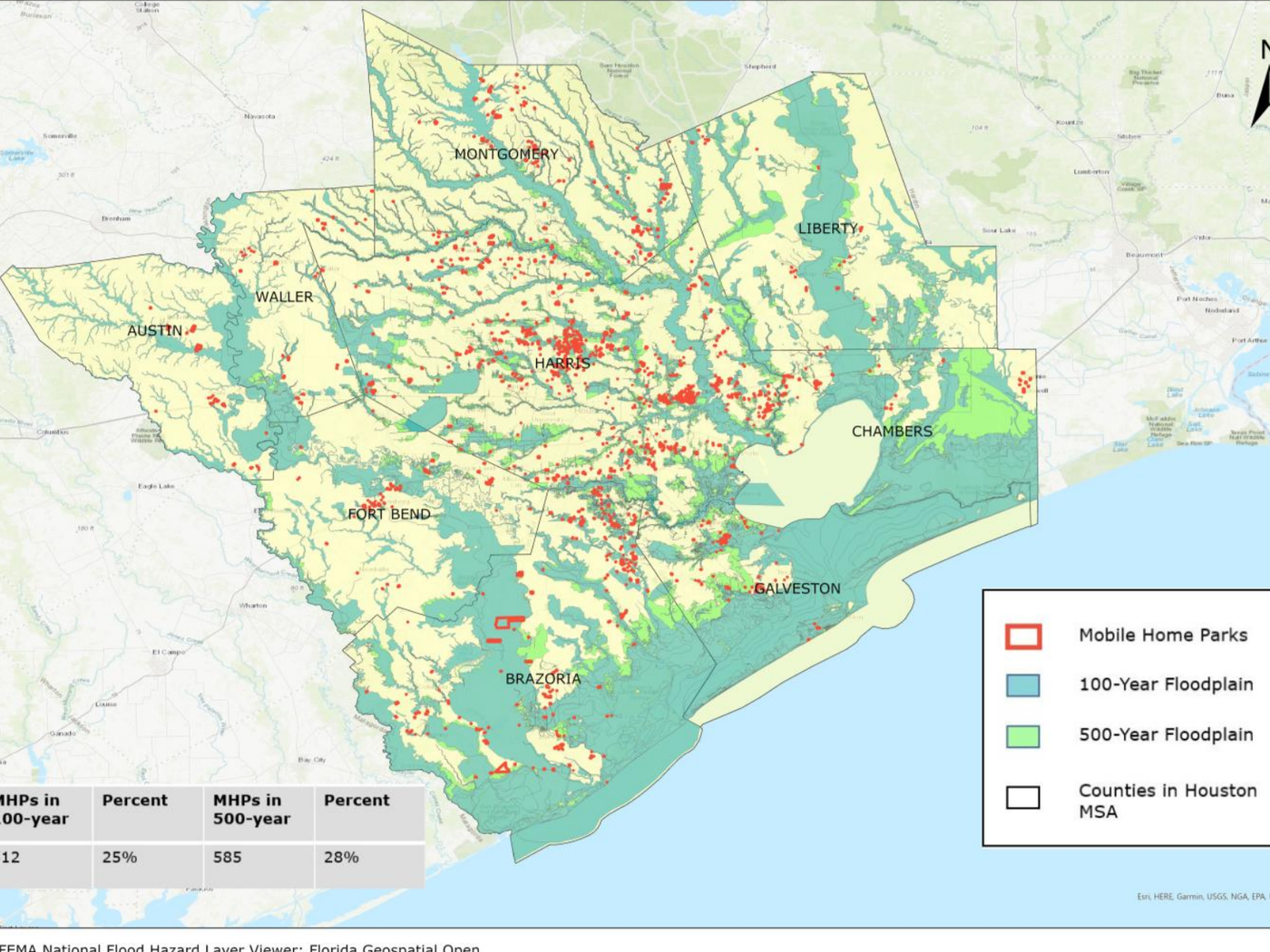
Because no national inventory exists, we built our own: identifying parks through tax-parcel land use codes, joining them to parcel boundaries, and counting units from pre-disaster satellite imagery. We overlaid these inventories with FEMA regulatory floodplains and with mid-range climate scenarios for sea-level rise, coastal storms, and high-tide flooding, and we coded the land use regulations of every jurisdiction in the Houston metropolitan area. In greater Houston alone, a quarter of the region’s 2,073 parks lie in the 100-year floodplain.
The work established mobile home parks as “America’s third housing type,” alongside owner-occupied and rental housing, with its own distinct risks. In Houston, parks are affordable but marginalized: they house more diverse, lower-income, and larger households, cluster in areas with fewer transportation options and amenities, and face greater exposure to environmental hazards. And even in a region famous for having no zoning, local governments use many other land use tools to exclude parks and treat them as something other than housing, which leaves their future uncertain. Our policy priorities include investing in state and national data on parks, making parks visible to mitigation and recovery programs, adopting state and federal legislation to guide local action, and exploring alternative ownership models. This research has helped bring manufactured housing communities into national housing policy debates.
Publications
- Rumbach, A., E. Sullivan, S. McMullen, and C. Makarewicz. 2022. You don’t need zoning to be exclusionary: Manufactured home parks, land-use regulations and housing segregation in the Houston metropolitan area. Land Use Policy 123: 106422.
- Sullivan, E., C. Makarewicz, and A. Rumbach. 2022. Affordable but marginalized: A sociospatial and regulatory analysis of mobile home parks in the Houston metropolitan area. Journal of the American Planning Association 88(2): 232–244.
- Rumbach, A., E. Sullivan, and C. Makarewicz. 2020. Mobile home parks and disasters: Understanding risk to the third housing type in the United States. Natural Hazards Review 21(2).
Presentation
Rumbach, A., E. Sullivan, C. Makarewicz, S. Jang, and S. McMullen. 2021. “Measuring the Impact of Climate Change on Mobile Home Parks: Evidence From Texas & Florida.” UCLA Luskin Center adaptation series.

