National Transportation Policies, Financing, and CO2 Policies of the United Kingdom, Canada, and Sweden: Lessons for the United States?
Prepared for the Bipartisan Policy Center’s National Transportation Policy Project · Presented at the 12th World Conference on Transport Research, Lisbon, July 2010
Carrie Makarewicz, Lee Schipper, and Elizabeth Deakin, Global Metropolitan Studies, University of California, Berkeley. Research assistance: Nicole Horn and Emily McGuire (UC Berkeley), Jakob Branger and Mustafa Wakid (ABB High School, Västerås, Sweden).
Abstract
As Congress debated a new federal surface transportation bill, the United States faced rising costs for its transportation system, dwindling revenue from an unpopular fuel tax, and growing carbon dioxide emissions from road vehicles. The Bipartisan Policy Center’s National Transportation Policy Project commissioned us to look for lessons from other wealthy, highly motorized democracies: how they set national transportation goals, assign responsibility across levels of government, finance their systems, and fold climate change into transportation policy.
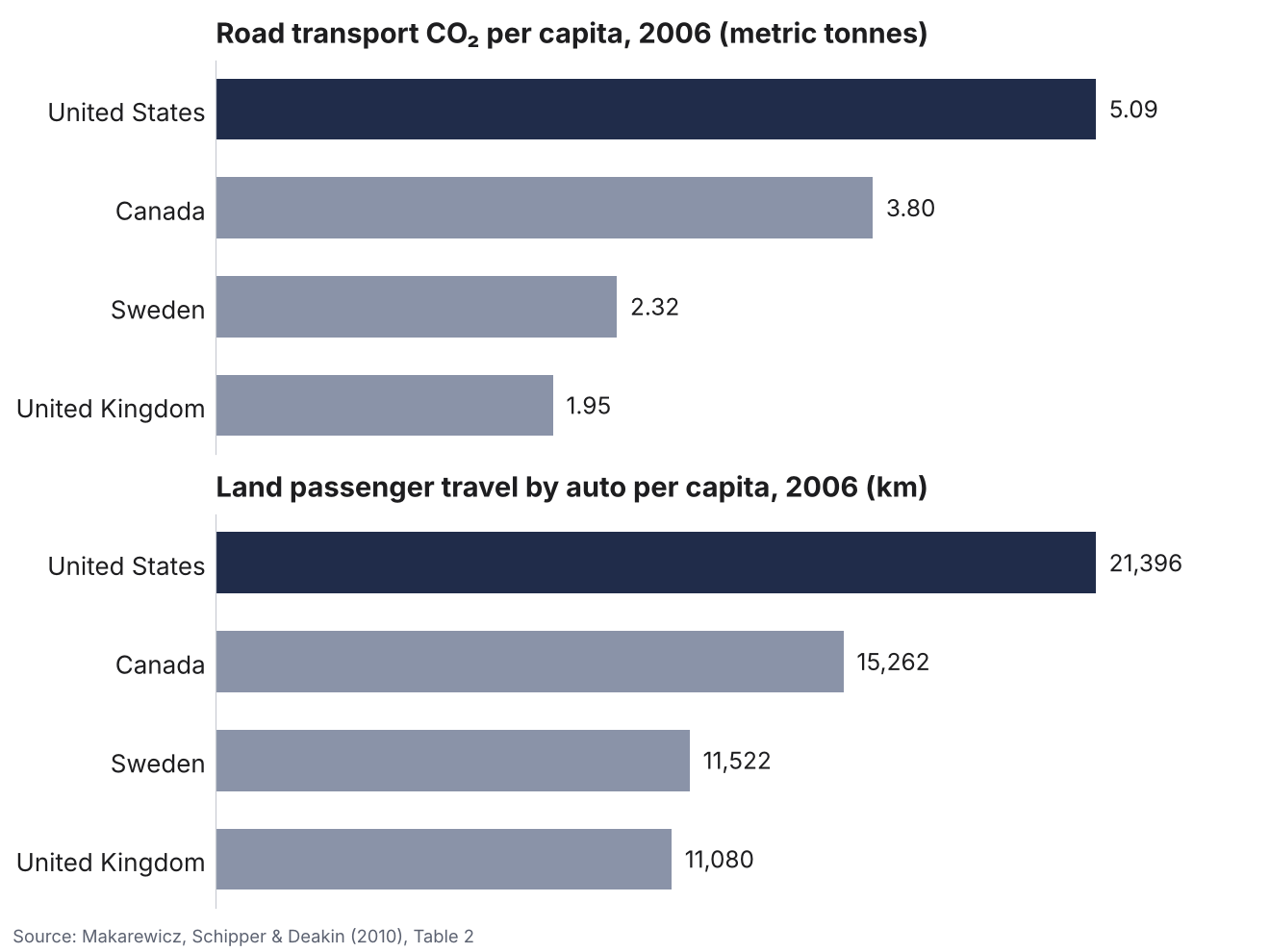
We compared the United Kingdom, Sweden, and Canada with the United States, drawing on government policy documents, budgets, and national and OECD data, with ten years of expenditures converted to comparable dollars. The three comparison countries have made sustainable development the centerpiece of policy, with national transportation goals that place equity and social development alongside safety, economic growth, and environmental stewardship, and with more coordination across agencies and levels of government on housing and infrastructure. They raise 137 to 291 percent more fuel tax revenue per capita than the United States, devote a larger share of transportation investment to transit and rail, and have a lower share of travel by car, more fuel-efficient vehicles, and lower CO2 emissions per capita from surface passenger transportation.
The United States spends more on transportation per capita than any of the comparison countries but gets a poorer return: households spend more on transportation, drive less efficient vehicles, emit more, and have fewer travel options. The paper concludes that the missing link in U.S. policy is connecting its goals to transportation taxation and finance, and recommends that national transportation policy adopt sustainable development as its organizing goal, with clear performance targets.
Paper
Makarewicz, C., L. Schipper, and E. Deakin. 2010. “National Transportation Policies, Financing, and CO2 Policies of the United Kingdom, Canada, and Sweden: Lessons for the United States?” Paper presented at the 12th World Conference on Transport Research, Lisbon, Portugal, July 11–15.

