30 Years of RTD Light Rail: Why 2% mode share and can it be improved?
2025–present · Presented at the Association of Collegiate Schools of Planning (ACSP) Annual Conference, October 2025
Carrie Makarewicz, Dani Slabaugh, Jack Suva-Urwin, and Mark Schenberger
Abstract
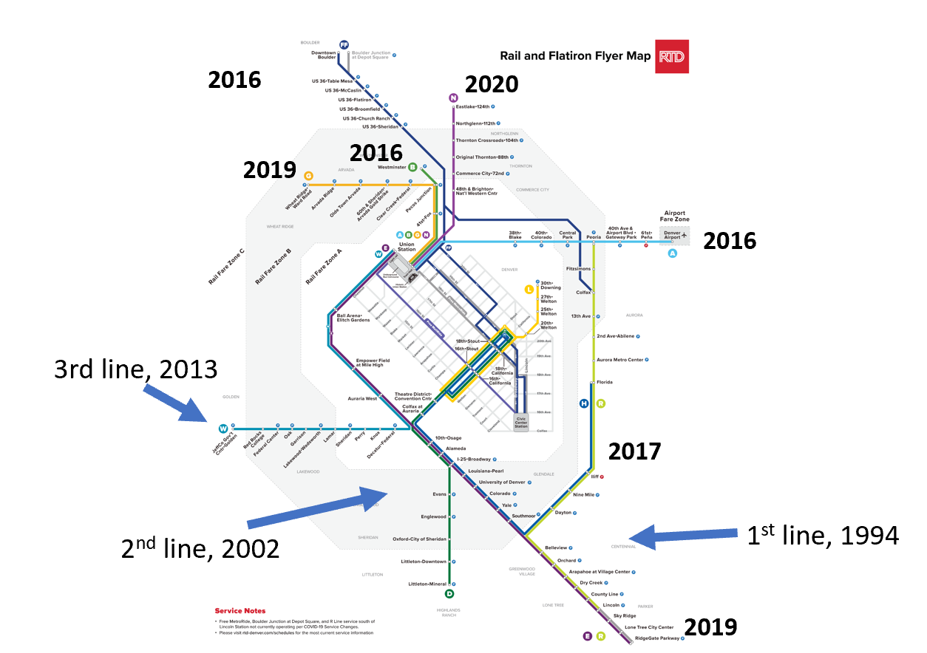
Since its first light rail line opened in 1994, the Regional Transportation District (RTD) has built a rail system of ten lines and 84 stations across the Denver region. Yet rail carries only about 2 percent of the region’s trips. This project asks why ridership is so low, what it will take to improve it, and whether Colorado’s recent state land use reforms and new transit funding sources can change the trajectory.
The study combines quantitative trend data, a regional land use and generalized zoning analysis of transit-oriented community (TOC) areas, multifamily permit data, an analysis of the region’s employment centers, station-area audits, and interviews, building on research conducted for the region’s HUD Sustainable Communities Initiative grant in 2014. Many of today’s problems were predictable. Densities near most stations remain too low, walkable commercial uses are scarce, wayfinding is missing or inadequate at every station, sidewalk and bike connections are incomplete, and hardened infrastructure consumes land that could be developed. Jobs are concentrated in centers the rail network serves unevenly, and lower-wage jobs are more prevalent in secondary and outlying centers that transit serves poorly.
Improving ridership will require coordinated action across land use, urban design, and transit operations. A journal article based on this work is in preparation.

