Seeking Housing Affordability in the Denver Metro Area: Detailing the causes and outcomes of the housing crisis to inform local and national solutions
Phase 1: 2014–2015, Denver region HUD–DOT Sustainable Communities Initiative grant · Phase 2: 2022–present, CU Denver Presidential Initiative on Urban and Place-Based Research
With CU Denver graduate research assistants
Abstract
The Denver metro area’s drive to become a “world-class” region brought world-class problems, chief among them a housing affordability crisis in which roughly 400,000 households, about 30 percent, are housing cost burdened. This two-phase study traces how the region got here and what can be done about it.
Phase 1 (2014–2015), part of the Denver region’s HUD–DOT Sustainable Communities Initiative grant, examined whether population and housing were growing near the region’s new rail stations. It found that jobs were densifying near transit faster than housing, that most station-area jobs paid modest wages, and that placing housing, especially affordable housing, near transit was constrained by site conditions, zoning, and cost.
Phase 2 (2022–present) takes a longitudinal view of housing production from 2005 to 2020. It asks how developers responded to local economic, regulatory, and demographic conditions; why the market built particular types of housing in particular places at particular times; and how detailed local housing-gap data might shape collective decisions by DRCOG’s Board of Directors and public messaging about affordable housing. The findings describe a “perfect storm”: production collapsed after the Great Recession while population kept growing, local zoning limited the types of homes that could be built, and the housing stock became increasingly mismatched with the region’s households by size and price. To support the analysis, the team built a generalized regional zoning dataset.
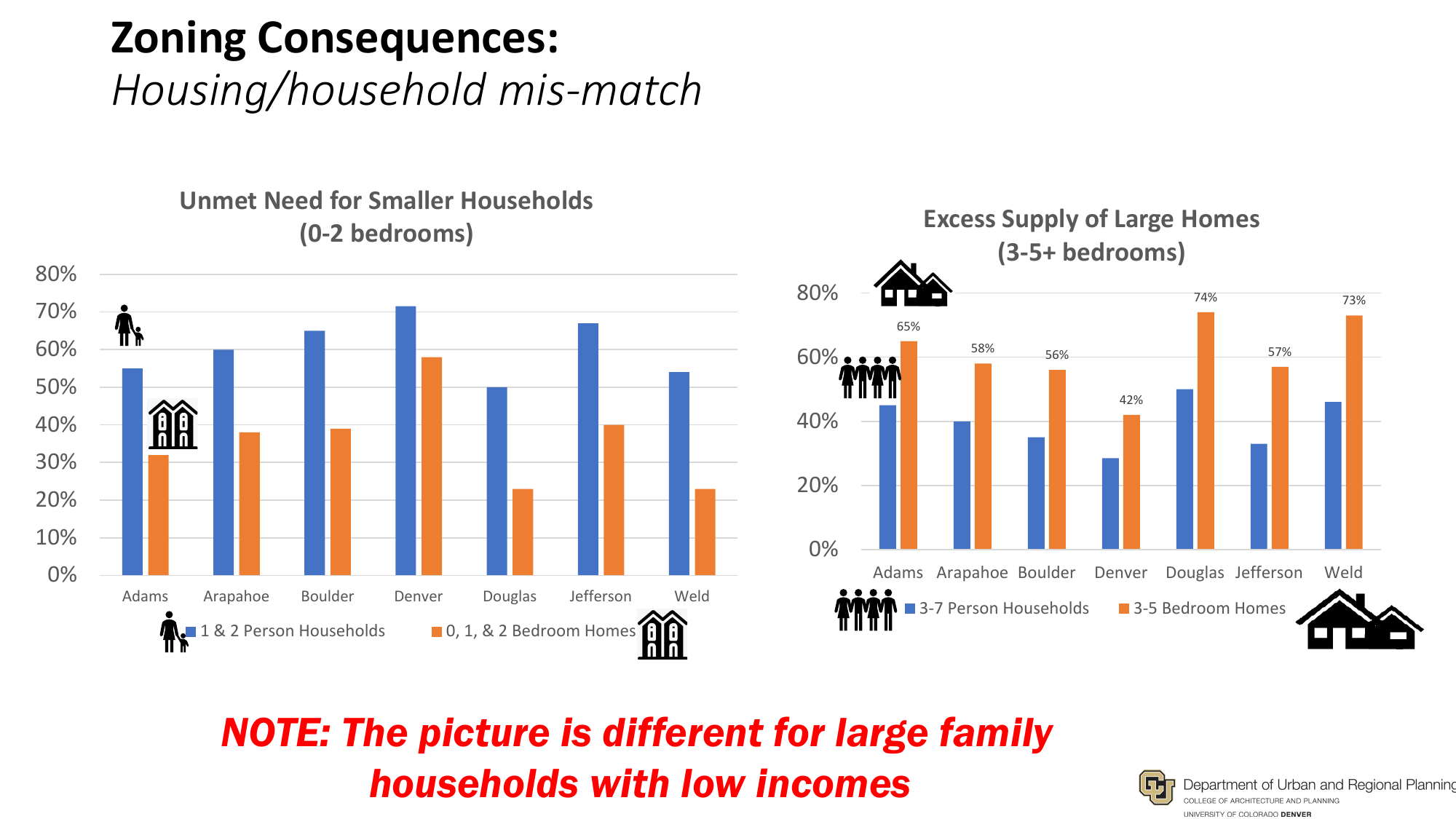
The size mismatch is stark. In every county, one- and two-person households far outnumber the supply of homes with two or fewer bedrooms, while homes with three to five bedrooms are in surplus relative to larger households. Yet that surplus does not reach everyone: large families with lower incomes still cannot find three- to five-bedroom homes, despite the surplus in each county.
The results have informed more than a dozen invited briefings to the DRCOG board, county commissions, mayors, city councils, and planning commissions, and the study is now being extended to the 56 largest U.S. metropolitan areas.

