Affordable and Resilient Transit Oriented Communities
National Science Foundation, Dynamics of Integrated Socio-Environmental Systems (DISES), “Building regional climate resilience and social equity through housing and land use policy” (Award No. 2409000), 2024–present · Co-PI
PI: Tanya Heikkila (School of Public Affairs). Co-PIs: Benjamin Crawford, Carrie Makarewicz, Wesley Marshall, and Austin Troy. Senior personnel: Jody Beck, Deserai Anderson, Farnoush Banaei-Kashani, and Robert Hobbins. Project website
About the project
Two interrelated crises, climate change and housing affordability, are reshaping the health and well-being of residents and the built, natural, and economic environments of regions. Transit-oriented communities (TOCs), with more homes near frequent transit, can help address both, but only if the policies, designs, and community support behind them hold together. Funded by a five-year, $1.8 million National Science Foundation Dynamics of Integrated Socio-Environmental Systems (DISES) award, this interdisciplinary CU Denver project asks how decision makers can promote climate resilience and housing equity together through TOCs.
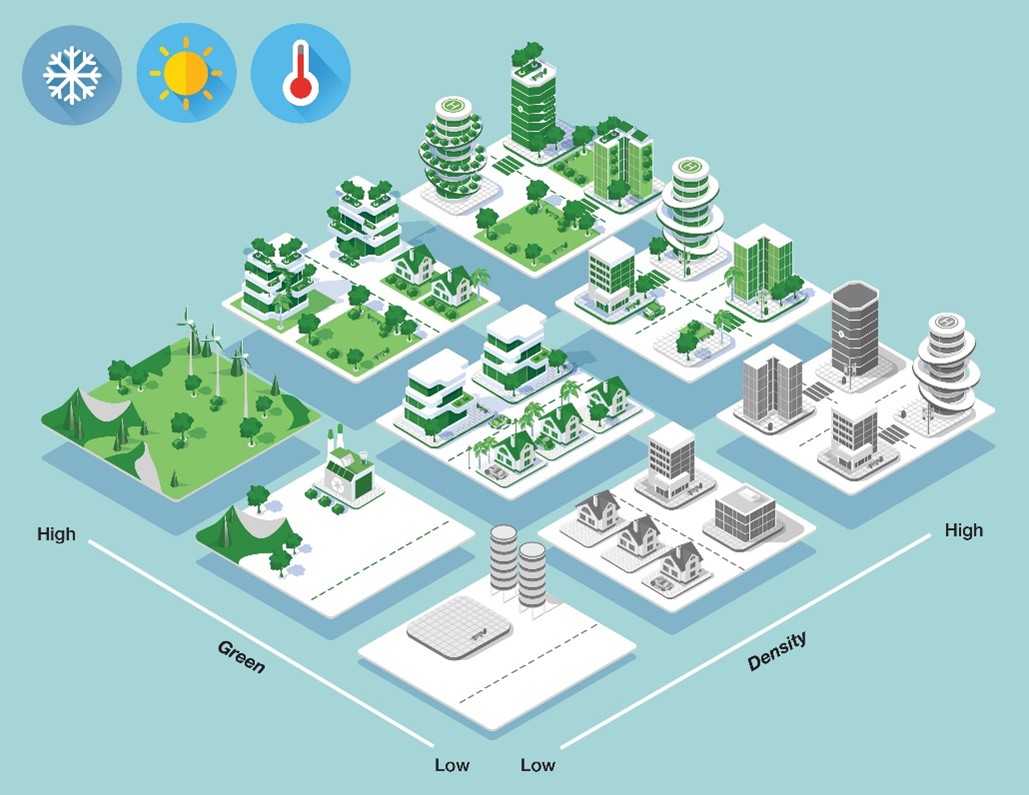
The project brings together faculty in public affairs, urban and regional planning, geography, civil engineering, landscape architecture, computer science, and business. It is organized around three aims: governance, identifying what enables or constrains climate-resilient and equitable TOC housing policies (years 1–3); biophysical research, characterizing the impacts of TOCs on climate resilience and housing equity, including the trade-offs and combinations of density and greening (years 2–4); and transformative capacity, co-producing knowledge with diverse stakeholders to build capacity for TOC development (years 4–5).
For the governance work, the team is using a large language model to code nearly 5,000 housing production policies across all 50 states, including bills that failed as well as those enacted, and interviewing subject-matter experts in five case-study states. The policy data are being developed in coordination with the NYU Furman Center’s Housing Solutions Lab policy tracker.
Current work
Passage and Failure of Transit-Oriented Affordable Housing Bills in Five States: Best Practice or Political Appeasement?
Carrie Makarewicz, Mark Schenberger, Jack Suva-Urwin, Christina Noto, and Cassa Niedringhaus
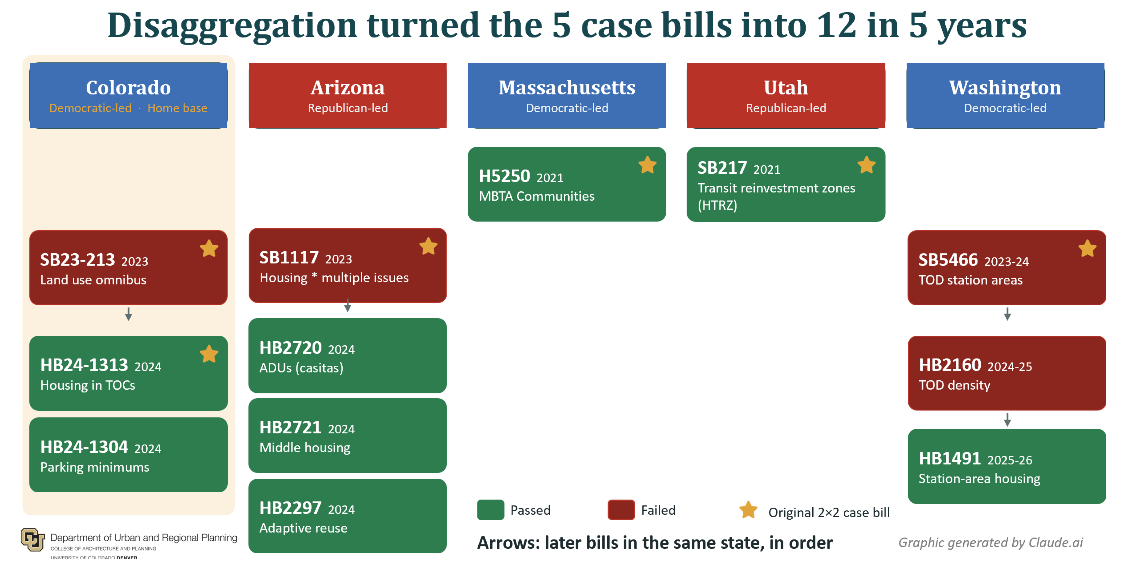
We used a most-similar case study design to examine 12 bills in five states, Massachusetts, Utah, Arizona, Washington, and Colorado, introduced from 2021 through Washington’s 2025-26 legislative session, that promoted affordable housing and climate resilience through transit-oriented communities, with instances of both passage and failure in Democratic- and Republican-led states. Using each legislator’s final vote as the unit of analysis (1,141 votes from 656 legislators), we compared votes with the characteristics of each legislator’s district. Bills that passed were incentive-based or had softer mandates that left some local control, and they drew at least one vote from the opposition party. Party was by far the strongest predictor of a legislator’s vote: holding district characteristics constant, a Democrat had roughly 27 times the odds of voting yes as a Republican. Among district characteristics, only transit commute share and the stock of dedicated affordable units were consistently associated with support, while density, cost burden, and home prices were not. Legislators who broke with their party to oppose a bill tended to represent districts on the urban edge that were still within the transit service areas the bill would affect. A new measure of how much of each district a bill actually reaches shows that Colorado’s failed 2023 omnibus would have reached 68 percent of the average district, while its two successful 2024 successors reach 33 and 15 percent.
Publications
- Scheetz, E., T. Heikkila, C. Makarewicz, and R. Hobbins. 2025. Policy learning over the legislative process: Insights from a statewide housing policy debate in Colorado. Policy Sciences 58(4): 705–731.
Related work
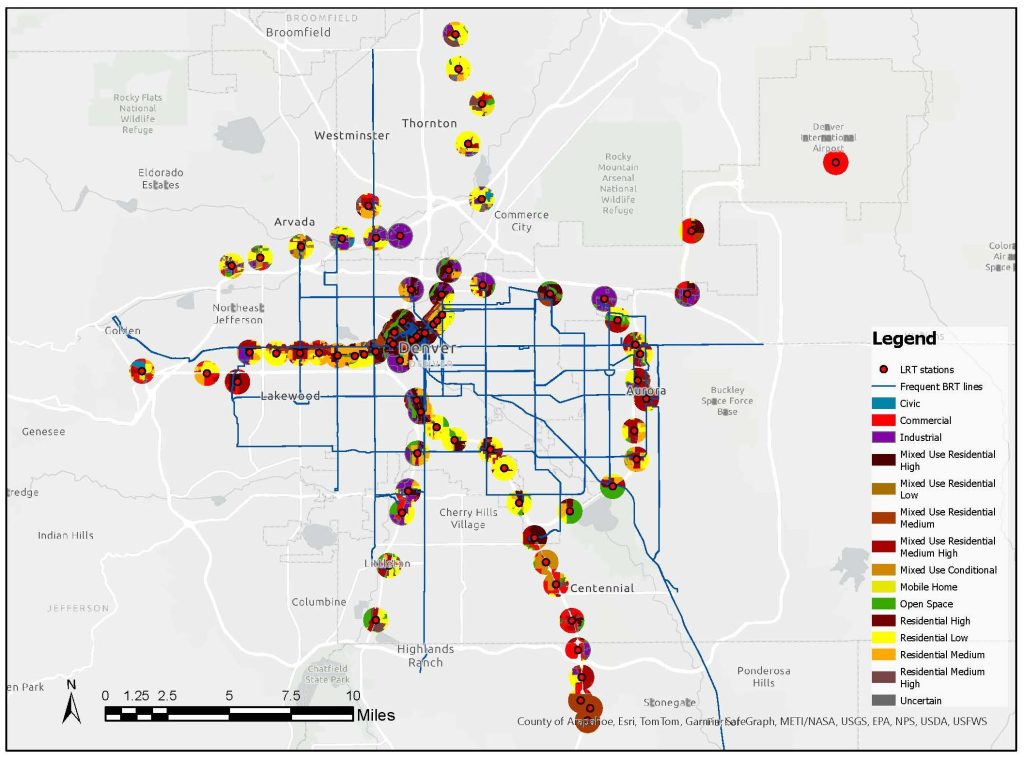
See also 30 Years of RTD Light Rail, which examines land use near Denver’s rail stations, and the 56-metro comparison of housing crises.
Mapping station-area zoning