Comparing Metro Housing Crises: Are They the Same Everywhere, and Could We Have Prevented Them?
Accepted abstract, International Conference on Urban Affairs (ICUA), New York City, April 14–16, 2027
Carrie Makarewicz, Laura Santos Granja, and Sydney Applegate
Abstract
Building on a study identifying eight reasons for the Denver region’s housing crisis, we ask whether these factors distinguish the other 22 large metropolitan areas (MSAs) ranked as housing-crisis regions from 33 other MSAs with over one million residents. Long-term factors are (1) single-unit zoning and construction alongside shrinking households, (2) absence of regional housing planning, (3) a demographic barbell of non-downsizing boomers and entry-level millennials, (4) wages lagging home prices, and (5) a high share of cost-burdened households since 1990. Near-term factors are (6) production decline after the Great Financial Recession, (7) investor-owned single-unit and short-term rentals, and (8) condo defects legislation.
We compile Census, ACS, and permit data for 56 MSAs and 442 counties by decade (1980–2022) to statistically compare crisis and non-crisis MSAs, adjusting for metro population. We also draw on 100 interviews with Denver region professionals from 2010 to 2014 to understand their failure to anticipate an eventual affordability crisis, given their focus on “world class” amenities and business attraction.
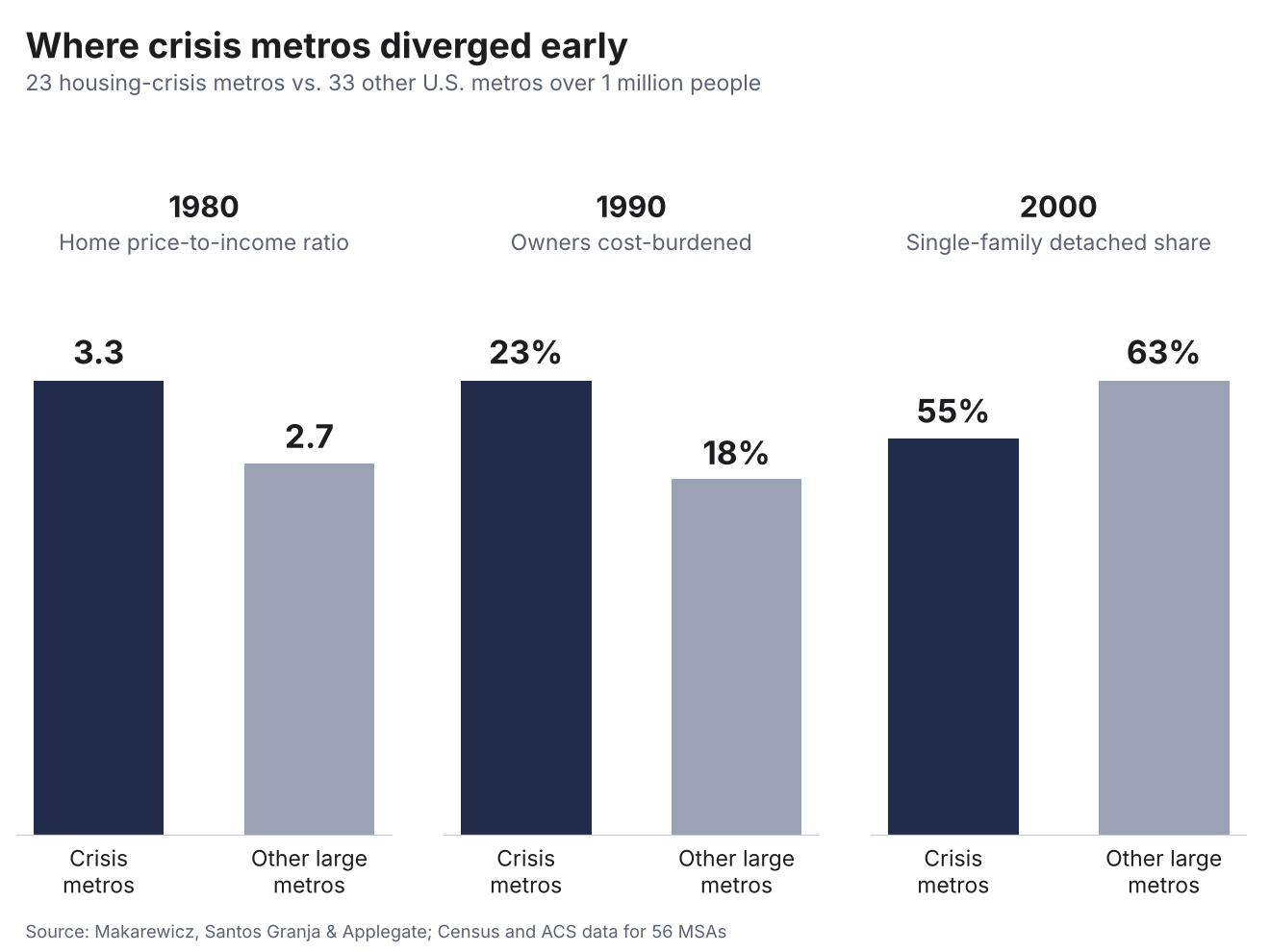
Crisis MSAs in 1980 had higher price-to-income ratios (3.3 vs. 2.7) and smaller average household sizes. By 1990, more owners were cost-burdened (23% vs. 18%); and by 2000 less of their housing was single-family detached (55% vs. 63%). By contrast, the post-GFR production decline, 2010–2022 price growth, and barbell population growth occurred nearly everywhere. Denver’s crisis matches most of the crisis regions but is unique in its low supply of two-to-four-unit housing structures (49th), the fastest rent growth from 2010–2022 (96%), and the second-largest post-2010 drop in owned multiunit housing (condos). Findings help inform long-range planning and current solutions to the crisis, including tailoring housing strategies by region to match housing structures and prices to household size and income.
Related work
This study extends the Denver region’s Seeking Housing Affordability study to the 56 largest U.S. metropolitan areas, with Denver as an embedded case, and uses the generalized regional zoning dataset built for that work.

